
Dedham Historical Directory Collections
Dedham directories survive, but not evenly. The Massachusetts State Library inventory lists volumes for 1874; 1876 to 1877; 1893; 1896; 1899; 1902; 1905; 1908; 1911; 1913; 1915; 1917; 1920 to 1921; 1923 to 1924; 1926 to 1931; 1939; 1941; 1946; and 1949. That holdings list is a catalogue of copies, not proof that every year is online. Gaps are real. The inventory also tracks Dedham voting lists through 2002. Voting lists are civic snapshots for a single date. Directories, by contrast, carry a broader trail of names, addresses, and businesses across many editions.
| Collection | Years | Where held | Access |
|---|---|---|---|
| Dedham directories in the State Library inventory | 1874 to 1949, selected years | Massachusetts State Library | Inventory, catalogue, and reading-room route |
| History and Directory of Dedham | 1889 | Digitized scan and local repositories | Resident, street, business, census, and history material |
| Dedham and Westwood resident and business directory | 1899 | State Library and local repositories | Directory with a map |
| Street and telephone directories | Multiple nineteenth and twentieth century years | Dedham Museum & Archive | In-person reference |
Note the exact edition and its coverage before searching any Dedham volume. A missing year rarely means a household vanished. It may mean no publication or no local holding. The State Library guide explains that directories usually arrange people by surname and may add a house guide by address, business categories, and advertisements.
Two Landmark Dedham Directories
Two Dedham books deserve special attention. The 1889 A.E. Foss & Co. volume, History and Directory of Dedham, Mass. for 1889, is far more than a name list. It combines a complete resident, street, and business directory with Massachusetts census material and town history. That mix helps. You can tell whether a result names a resident, a firm, an institution, or a public facility sitting on the same page. The 1899 E.A. Jones volume is a different object. Resident and business directory of Dedham and Westwood, Mass. joins two neighboring communities and includes a map. The pairing matters. Someone connected to both postal areas may appear in a way that a strictly town-based search would miss. The 1889 book also splits same-name residents. Its business categories cover grocers, boarding houses, physicians, lawyers, dressmakers, and ice dealers, so an occupation or business address can distinguish two Dedham households with matching surnames. Record the source spelling, initials, and address first. Normalize only later. Note: The 1889 and 1899 books differ in scope, arrangement, and geographic reach, so treat them as separate snapshots.
Dedham Archive Directory Shelves
The Dedham Museum & Archive holds the local shelf of Dedham directories. Street directories sit beside telephone books for Dedham and nearby towns including Westwood. The shelves also hold building-history files, family material, maps, yearbooks, church and civil records, and newspapers that begin in 1796. A collections database can be searched through PastPerfect Online. Many physical sources, though, are reached only in person. Members use the reference library and archive free. Non-members pay $25 for in-person archive research. Contract research runs $25 per hour for up to two hours.
The Dedham Public Library adds statewide research tools and reference help. Its database listing names Ancestry Library Edition as an in-library resource. The library stands at 43 Church Street, and the Museum at 612 High Street. The State Library keeps the more systematic directory and voting-list inventory. The Museum supplies the local building, newspaper, family, and street context that turns a bare entry into something useful.
The Dedham Public Library database listing shows the local genealogy access point. It includes the in-library Ancestry Library Edition resource.
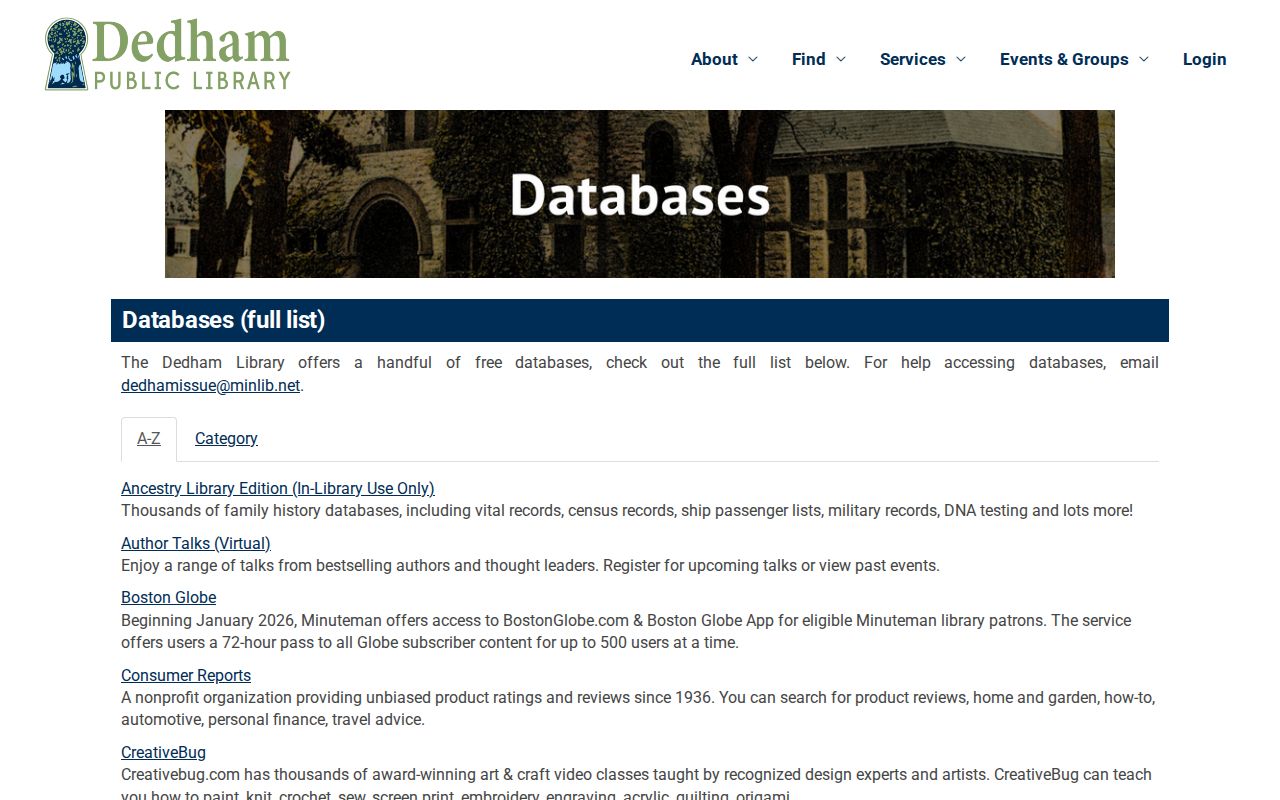
Pair the library resource with a dated Dedham directory. Then confirm the household against a census, vital, military, or other independently created record.
Dedham Directories and Building Files
An address is only the start. A dated Dedham directory does not prove a building's full history. Pair it with the Museum's building files and maps when a house number seems unfamiliar. The Massachusetts State Archives Dedham digital folder includes building and index cards. Fields cover street, owner, use, architect, inspector, and date. For an earlier view, turn to the Library of Congress. Its 1892 Sanborn set offers six public-domain Dedham sheets. The backdrop runs deep. Norfolk County began in 1793. The Norfolk County Registry of Deeds has remained in Dedham ever since. A directory address can be matched to a later tax parcel or deed description. Still, never force a modern street number onto an old entry. Search the street spelling, neighborhood name, map, building file, and deed description together.
Reading a Dedham Directory Entry
Read every Dedham line before drawing a conclusion. The 1889 volume shows several entry types. Expect alphabetical resident names with town or section context, street-directory lines, and business or occupation categories. The history pages, census material, and advertisements help identify whether a result names a resident, a firm, an institution, or a public facility. Abbreviations deserve caution. The printed volume offers no complete abbreviation key, spouse convention, tenure symbol, or employer field in plain text. Check the scanned page rather than assume.
| Resident name | Use the spelling, initials, and town or section context shown in the alphabetical listing. |
|---|---|
| Street line | Record the number, street spelling, and any related household entry from the street section. |
| Occupation or business | Where present, use it to distinguish same-name people or connect a person to a business listing. |
| Town history and advertisements | Read surrounding material before treating a named place or organization as a personal entry. |
- House guide
- An address-ordered part of a directory that can connect a street to an occupant name.
- Criss-cross directory
- A later reverse-style directory arranged from address or street toward the listed household or business.
- Abbreviation key
- The volume's explanation of its shortened labels. Photograph or transcribe it before interpreting an unfamiliar mark.
Trace Dedham Directories by Household
Tracking one Dedham household across editions works best in dated order. Start with the house guide or street portion when the address is known. Then move to the alphabetical section, which catches spelling variants and business details. The federal census offers a second opinion on age, household relationships, and occupation. The 72-year rule holds census records back. The 1950 census is the newest federal count open to the public. A later Dedham tax parcel or deed can separate an owner from an occupant. Even so, it cannot replace the directory. The directory's own evidence shows someone lived in town at a given moment. Treat the two record types as partners, not substitutes.
- Copy the address, street spelling, surname, household names, and any occupation marker from the first located edition.
- Check the alphabetical section for variant spellings, relatives, and business references.
- Compare the nearest available Dedham directory years, recording moves rather than assuming continuity.
- Pair a directory year with the appropriate federal census and use age, relationship, and occupation to test a same-name match.
- Use a deed, tax parcel, obituary, probate, church, cemetery, or newspaper record to corroborate the ending or transition.
A family that left Dedham for Westwood or another nearby town may appear in the 1899 combined directory. The Dedham Museum's telephone books cover later moves as well. Once the historical trail ends, the Dedham street directory picks up the modern parcel and street-record route for address-keyed searches.
Dedham Directory Timeline
The surviving editions trace how Dedham record keeping changed form. Early town and church material came first. It predates the county land system entirely. Dedham's directory tradition later grew into something richer. It paired alphabetical residents and addresses with businesses, advertisements, and local history. Custody of these records now splits among local, county, and state repositories. One archive's gap rarely breaks the person trail.
- 1874: the earliest Dedham directory year listed in the State Library inventory.
- 1889: A.E. Foss & Co. issued its Dedham history, resident, street, and business volume.
- 1899: E.A. Jones published the combined Dedham and Westwood directory with a map.
- 1949: the latest selected directory year stated in the State Library run.
- 2002: the last selected Dedham voting-list year identified in that inventory.
Note: A catalogued year proves a holding exists, not an unbroken annual publishing schedule or full online availability.
Dedham Directory Companion Records
Different Dedham collections answer different parts of the same question. FamilySearch catalogs Massachusetts town and vital records. This includes an 1887 to 1896 reprint of Dedham town-meeting and vital-statistics volumes. The Dedham FamilySearch catalog entry confirms that indexed set. Image access, though, can depend on an account or affiliate-library permissions. The Dedham Museum holds newspapers, yearbooks, church records, local genealogies, military material, and family papers. That context goes well beyond anything a residents directory ever tried to capture.
Naturalization papers help with a common name. Dedham declarations and petitions survive for 1906 to 1931, with Norfolk-related abstract coverage alongside them. For a death or family link, go deeper. Start with the vital, probate, church, or cemetery record whenever one exists. Remember that a yearbook or directory is a historical snapshot. It is not conclusive proof of identity or relationship.
Note: Handle sensitive addresses and personal details with care. Use these records only for lawful genealogy, estate, civic, or reconnecting purposes.
Dedham Directory Access Gaps
Call or email each Dedham repository before traveling. Ask for the exact title, year, and access format. The Dedham Public Library publishes no full year-by-year online inventory. Its directories, microfilm, and obituary indexes are not itemized online. The State Library's PDF is an inventory, not a digitization promise. The Dedham Museum can confirm access to fragile directories, newspaper volumes, maps, and building files. The public library answers database questions by email. These routes beat assuming every directory has a searchable digital copy.
For place and family context, try the Dedham Museum first. For systematic directory and voting-list coverage, the State Library wins. For statewide town and vital material, FamilySearch and the State Archives are the strongest stops. Each Dedham collection was built for its own purpose. Keep its citation beside every Dedham fact copied from it.